
Staying ahead in tech industry trends 2026 isn’t just about curiosity—it’s about making smarter decisions in a landscape that’s evolving faster than ever. From AI-powered workflows and next-gen devices to shifts in software architecture and digital ecosystems, the signals shaping tomorrow’s technology are already emerging today.
If you’re searching for clarity on what’s actually driving innovation—and what’s just hype—this article breaks it down. We analyze current data, industry reports, product roadmaps, and expert commentary to identify the trends that will have real impact in 2026.
You’ll discover which technologies are gaining serious traction, how digital transformation is reshaping businesses, and what practical tech advancements mean for developers, creators, and everyday users. Whether you’re a tech enthusiast, builder, or strategic decision-maker, this guide is designed to give you a clear, trustworthy view of where the industry is heading—and how to stay ahead of it.
Beyond the Hype: A Pragmatic Forecast for the 2026 Tech Landscape
Buzzwords fade, but practical systems compound value. In 2026, the winners will integrate intelligent agents, ambient computing, and decentralized infrastructure into everyday workflows. For you, that means fewer repetitive tasks, faster product cycles, and resilient architectures that scale without drama (yes, even during traffic spikes). The real opportunity isn’t chasing shiny demos; it’s embedding automation where it saves time and deploying edge-ready stacks that cut latency and costs. Track tech industry trends 2026 strategically, and you’ll invest in skills and platforms that deliver measurable ROI instead of hype. Today.
The Great Compute Crunch: AI’s Insatiable Demand Reshapes Hardware
The problem is simple: AI wants more compute than the planet comfortably provides. Training frontier Large Language Models (LLMs)—AI systems trained on massive datasets to predict and generate text, images, or code—now consumes gigawatt-hours of electricity. Data centers in Northern Virginia and Shenzhen are hitting grid ceilings (yes, actual power-plant limits). The bottleneck isn’t hype; the International Energy Agency notes data center demand could double by 2026 (IEA, 2024).
Some argue general-purpose GPUs are still enough. After all, NVIDIA’s CUDA ecosystem dominates. But in 2026, hyperscalers in Silicon Valley and Taipei are pivoting to ASICs (Application-Specific Integrated Circuits—chips built for one task) and neuromorphic chips that mimic neural structures. WHY? Efficiency. ASICs slash redundant instruction cycles; neuromorphic designs cut memory-transfer overhead, the real energy hog.
This hardware pivot reshapes software. Monolithic training pipelines are fading. Distributed computing—splitting workloads across clusters with low-latency interconnects like NVLink or InfiniBand—is now default. Hyper-efficient code, memory locality optimization, and sparsity-aware models are competitive advantages. In tech industry trends 2026 briefings, energy per inference is a KPI.
Counterpoint: specialized chips risk vendor lock-in and reduced flexibility. True. But when power costs eclipse hardware costs, efficiency wins.
Practical hack: profile energy, not just runtime. Use mixed-precision training, prune redundant parameters, minimize data movement, and batch intelligently. PRO TIP: optimize memory access before tweaking math kernels (it’s the silent killer).
Ambient Computing Arrives: The Disappearing Interface and Pervasive AI
Remember when “smart” meant tapping a glowing rectangle? That era is fading. Ambient computing—technology embedded invisibly into everyday spaces—turns smart devices into intelligent environments. Instead of wearing tech, you walk through it. Lights adjust, cars reroute, rooms respond. It sounds magical. It’s also overdue.
Because let’s be honest: constant notifications, clunky apps, and five-step logins are exhausting. Zero friction is becoming the defining UX principle of 2026. Zero friction means systems anticipate needs using contextual data (location, behavior patterns, biometrics) without explicit commands. Think your thermostat learning routines without endless setup screens. Or your car suggesting a charging stop before you ask. (Finally.)
Screenless interfaces—voice-first assistants, gesture recognition, spatial audio cues—are replacing touchscreens in homes and public spaces. Critics argue this erodes privacy and increases surveillance risk. Fair point. Intelligent environments rely on edge computing (processing data locally) to reduce exposure, but governance still lags innovation.
Ultra-low-latency networks—6G precursors and Wi-Fi 7—enable real-time responsiveness measured in milliseconds, making ambient systems feel instantaneous rather than awkwardly delayed (because nothing kills “smart” like lag).
Many investors tracking tech industry trends 2026 are watching this shift closely, especially in areas like how venture capital is influencing emerging technology sectors.
Pro tip: Design for subtlety. The best interface is the one users barely notice—until it’s gone.
The Composable Enterprise: Why Monolithic Software is Finally Dead

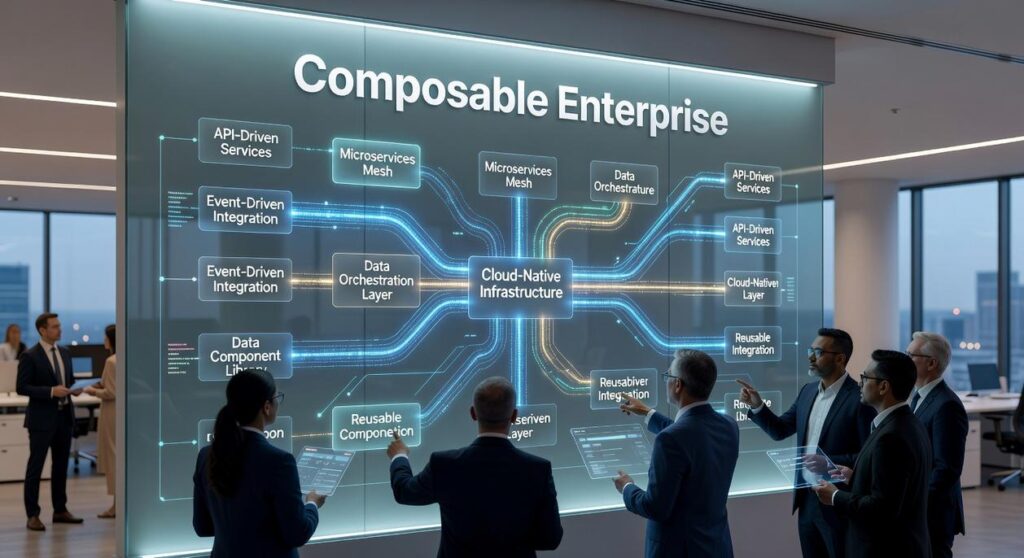
For decades, companies relied on monolithic software—large, tightly connected systems where every feature lived inside one massive codebase. It worked… until it didn’t. Today, the composable enterprise has taken center stage.
A composable enterprise is built from interchangeable, API-first modular components—often called MACH architecture (Microservices, API-first, Cloud-native, Headless). In simple terms, each business capability runs independently but connects through APIs (Application Programming Interfaces, which allow systems to communicate).
Monolith vs. Composable: A Clear Comparison
Monolithic Software
- One large, unified system
- Slow updates and risky deployments
- Expensive full-system overhauls
Composable Architecture
- Independent microservices
- Rapid feature deployment
- Flexible vendor and tool integration
At first glance, critics argue monoliths are “simpler” to manage. And yes, fewer moving parts can mean fewer coordination headaches. However, that simplicity collapses under scale. When integrating AI tools or responding to tech industry trends 2026, monoliths often require invasive rewrites. Composable systems, by contrast, swap or upgrade components without disrupting the whole.
Consider a 2026 retail brand launching an augmented reality try-on feature. With a composable stack, it connects inventory APIs, customer profile services, and a cloud rendering engine instantly. No core rewrite—just orchestration. (Think LEGO blocks, not poured concrete.)
As a result, demand is rising for skills in:
- API design and lifecycle management
- Microservices orchestration
- Platform engineering
Pro tip: Engineers who understand system boundaries—not just code—will lead this shift.
In the end, composable isn’t just modern—it’s survival.
Digital Identity and the Decentralization Dilemma
Every time a major platform announces a data breach, the same question resurfaces: why are we still handing over our identities to centralized databases? A centralized platform is a single authority that stores and controls user data. When it fails, millions are exposed at once (think of it as keeping every house key in one giant vault).
The emerging alternative is Self-Sovereign Identity (SSI). SSI means you control your digital identity instead of a corporation. It relies on decentralized identifiers (DIDs)—unique, blockchain-anchored IDs you own—and verifiable credentials (VCs), which are cryptographically signed proofs of information like your degree or license. These proofs can be verified without contacting the original issuer each time.
In practical terms, by 2026 you might open a digital wallet app and prove you’re over 18 without revealing your exact birthdate. Applying for a job? Share a verified credential confirming your certification instead of emailing a full resume with your address and references. That’s data minimization—sharing only what’s necessary (finally, privacy by design instead of privacy by policy).
Not everyone is convinced. Critics argue federated identity systems like “Sign in with…” are more convenient and already widely adopted. They’re not wrong—ease of use matters. But federated models still centralize power with Big Tech. If the provider suspends you, your digital life can stall.
The push for decentralized protocols reflects broader tech industry trends 2026 focused on user ownership and interoperability. Pro tip: start exploring wallets that support DIDs now so you’re not scrambling later.
It’s less “The Matrix” and more practical security hygiene—own your keys, own your identity.
Your Action Plan for the Next Wave of Tech
You can almost hear the hum of overworked servers and feel the heat of the compute crunch pressing against your stack. The real shift in tech industry trends 2026 isn’t shinier apps; it’s efficiency, modularity, and user control. Think Lego, not concrete. Some argue monoliths feel safer, sturdier, easier to manage. Fair. But when markets pivot overnight, rigidity cracks loud and costly. Audit your tools and skills. Do they click together smoothly, or grind like rusty gears? Prioritize composable architecture, ambient intelligence, decentralized identity. Pro tip: measure energy and latency now.
Stay Ahead of What’s Next in Tech
You came here to understand where innovation is heading and how the latest shifts will impact your decisions. Now you have a clearer view of the forces shaping tech industry trends 2026 — from evolving software architecture to emerging devices and smarter digital workflows.
The real challenge isn’t finding information. It’s keeping up before the next wave leaves you behind. Technology moves fast, and falling even slightly out of sync can cost you efficiency, relevance, and opportunity.
Here’s your next move: stay plugged into consistent, actionable tech insights that translate trends into practical steps. Follow the latest updates, explore deeper breakdowns of new tools, and start applying the hacks and strategies that keep you competitive.
If you’re serious about staying ahead of disruption instead of reacting to it, now’s the time to act. Join thousands of readers who rely on our forward-thinking analysis to simplify complex tech shifts and turn them into real-world advantages. Stay informed, stay adaptable, and make your next move smarter.